How can scientific knowledge make its way from research into society, policymaking, and practice? This question was at the heart of the EULiST Interactive Conference “Make Science Matter” in Brussels, organized by the European University Alliance EULiST, of which TU Wien is a member. Representatives from European universities, political institutions, and other societal stakeholders came together to discuss how research can contribute more effectively to addressing current challenges and what role science communication plays in this process.
At the core of the conference was the conviction that science should not remain confined to universities but should make a tangible contribution to society. Research findings should play a stronger role in political decision-making, strengthen public trust in scientific knowledge, and help develop solutions to current societal challenges. At the same time, participants emphasized that achieving these goals requires close collaboration between academia, policymakers, industry, and civil society. Against this backdrop, the importance of science communication, stakeholder engagement, and knowledge transfer was repeatedly highlighted. Scientific excellence alone is not enough. Research must be communicated clearly, discussed with relevant societal stakeholders, and translated into practical and policy-relevant applications in order to generate lasting impact.
These are also key focus areas of the CTSi – Center for Technology-driven Social Innovation at TU Wien. Within the EULiST Alliance, the CTSi, represented by Anna Franzkowiak, leads the “Science Communication Training” Task Group, thereby contributing its expertise in science communication at the European level. For the conference, the CTSi developed a roll-up on science communication that illustrates how research can create societal impact through clear communication and active engagement with relevant stakeholders.
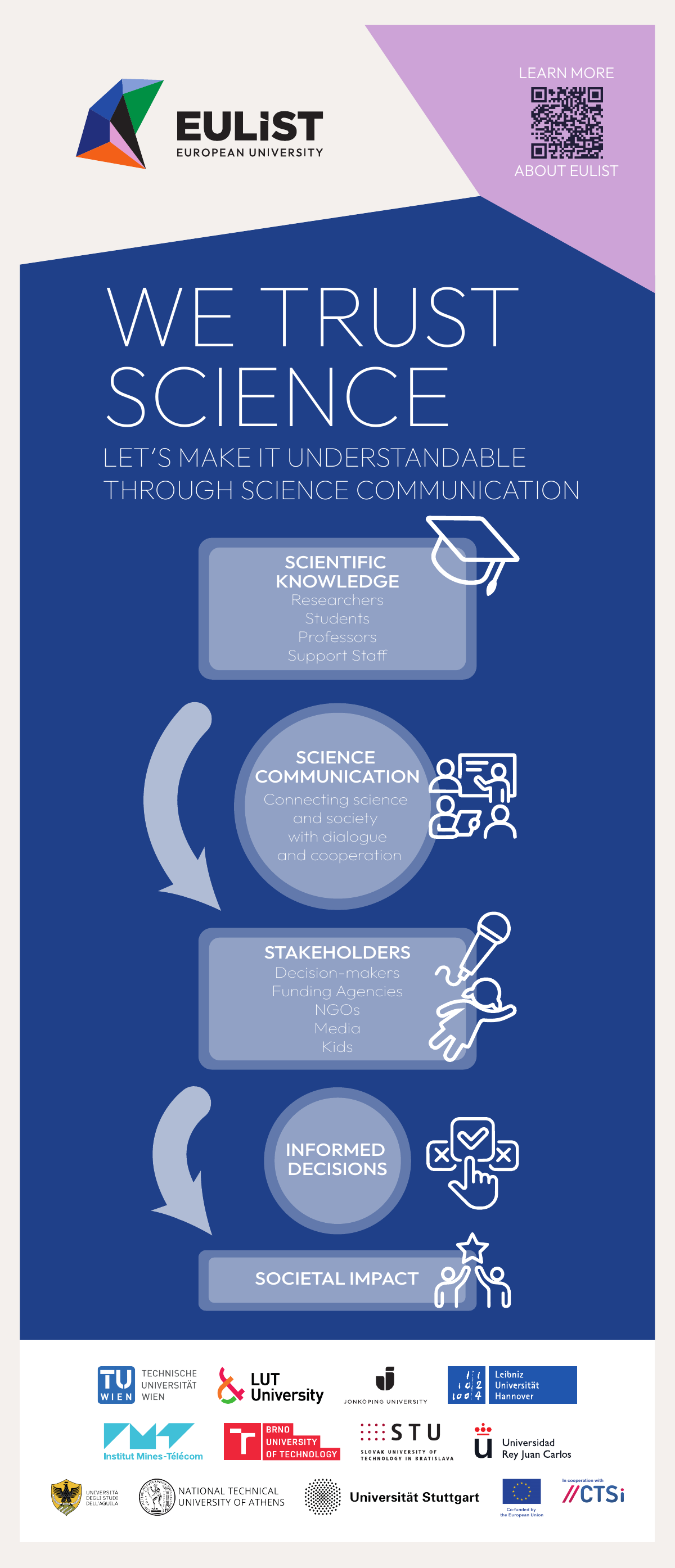
Under the guiding principle “We Trust Science – Let’s Make It Understandable Through Science Communication”, the roll-up presents science communication as a crucial bridge between scientific knowledge and society. It highlights that this knowledge can only reach its full potential when it is communicated in an accessible way, discussed openly, and made available to different target groups. Science communication thus becomes an important tool for building trust in research, strengthening the dialogue between science and society, and supporting the transfer of scientific knowledge into policy and practice.
Through its training and professional development activities, the CTSi specifically addresses these needs. The courses are designed to support TU Wien staff members as well as junior and senior researchers in developing competencies in science communication and knowledge transfer. The aim is to empower these target groups to communicate their research findings effectively, integrate societal needs into research processes at an early stage, and bring their expertise into practice and policymaking in a targeted way. This is intended to make research not only more visible but also valuable beyond academia.
The CTSi’s work thus ties in directly with TU Wien’s strategy, which aims to position TU Wien as a leading institution for the exchange of knowledge, methods, and technologies and explicitly names engagement with stakeholders and the expansion of continuing education opportunities as instruments of knowledge transfer. This is precisely where the courses and the work within the EULiST Alliance come in.
The CTSi also supports a further objective of the strategy: making scientific knowledge more relevant for societal development and increasing its influence on societal decision-making. The cross-cutting theme of “Holistic Communication” is reflected here as well: making science visible, fostering dialogue with society, and making scientific knowledge accessible and meaningful for society and policymakers.
The discussions at the EULiST Interactive Conference “Make Science Matter” demonstrated that successful research today does not only generate new knowledge. It must also communicate that knowledge effectively and integrate it into societal and political processes together with relevant stakeholders. Through its role in the EULiST “Science Communication Training” Task Group and its training courses, the CTSi supports researchers in developing exactly these competencies, strengthening trust in science, and increasing the contribution of scientific knowledge to solving concrete societal challenges. In doing so, the CTSi helps bring science, policy, and society closer together and supports TU Wien’s mission of “Technology for People”, which understands research as an active contribution to shaping the future of society.

Header image: © Alexander Doyle / Babylonia